 By admin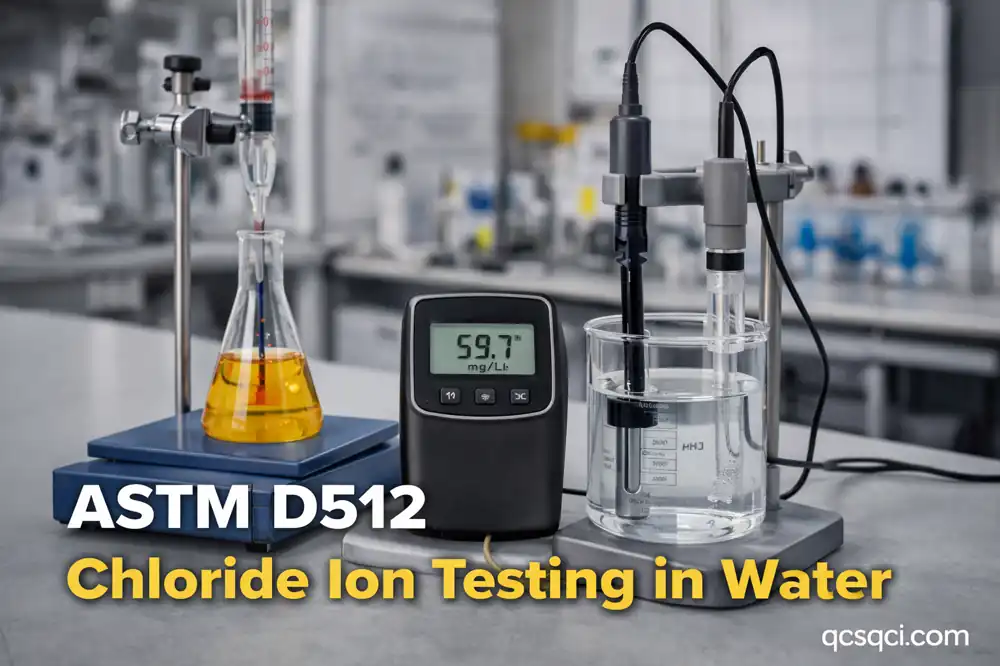
Chloride ion (Cl⁻) is one of the most important parameters in water quality analysis. The ASTM D512 standard provides reliable test methods for determining chloride ion concentration in water, wastewater, and brines.
Accurate chloride measurement is critical for boiler systems, cooling towers, stainless steel equipment, and food processing industries, where excess chloride can cause corrosion and operational damage.
What is ASTM D512?
ASTM D512 is a standard test method that describes three analytical procedures for determining chloride ion in water:
- Test Method A – Mercurimetric Titration
- Test Method B – Silver Nitrate Titration (Mohr Method)
- Test Method C – Ion-Selective Electrode (ISE) Method
Each method is suitable for different sample types and concentration ranges.
Why Chloride Testing is Important
Chloride ion analysis is essential because:
- It prevents corrosion in high-pressure boiler systems
- Protects stainless steel equipment
- Helps monitor cooling tower cycles of concentration
- Ensures compliance with regulatory water standards
- Supports quality control in food processing industries
High chloride levels can accelerate pitting corrosion and structural degradation.
Test Method A – Mercurimetric Titration
Principle
Mercuric nitrate is titrated into an acidified sample using a diphenylcarbazone indicator. The endpoint is identified by a blue-violet color formation.
Applicable Range
- 8 to 250 mg/L chloride
Advantages
- Good accuracy
- Suitable for laboratory control testing
Limitations
- Interference from bromide, chromate, ferric ion
- Requires careful pH control (3.0–3.5)
How to Check Salt Contamination on Steel Surfaces Before Painting
Test Method B – Silver Nitrate Titration (Mohr Method)
Principle
Chloride reacts with silver nitrate in the presence of potassium chromate indicator. The endpoint is a brick-red silver chromate color.
Applicable Range
- ≥ 5 mg/L chloride
- Validated from 8 to 250 mg/L
Advantages
- Widely used
- Simple titration procedure
- Suitable for routine water testing
Limitations
- Interference from bromide, iodide, sulfide
- pH must be adjusted to 8.3
Test Method C – Ion-Selective Electrode (ISE)
Principle
A chloride ion-selective electrode measures chloride concentration potentiometrically using millivolt readings.
Applicable Range
- 2 to 1000 mg/L chloride
- Extendable by dilution
Advantages
- Rapid analysis
- Suitable for wastewater and natural waters
- Less operator-dependent
Limitations
- Requires calibration curve
- Sensitive to contamination
Precision and Bias
ASTM D512 provides precision equations for each method based on interlaboratory studies.
The ion-selective electrode method demonstrates excellent repeatability across:
- Reagent water
- Natural waters
- Wastewater matrices
Accuracy depends on:
- Proper reagent purity
- Correct pH adjustment
- Calibration quality
- Matrix suitability
Choosing the Right Chloride Test Method
| Situation | Recommended Method |
|---|---|
| Routine lab testing | Silver Nitrate (Method B) |
| Low chloride levels | Ion-Selective Electrode |
| Regulatory compliance | Method B or C |
| Industrial water systems | Method C |
Safety Considerations
- Handle silver nitrate and mercuric nitrate carefully.
- Use proper PPE.
- Sodium bromate (ISE method) is a strong oxidizer.
- Follow laboratory safety procedures.
FAQs
Limits vary depending on application. Drinking water guidelines commonly recommend less than 250 mg/L chloride.
The Silver Nitrate (Mohr) titration method is widely used in laboratories.
Yes, especially the Ion-Selective Electrode method (Test Method C).
Bromide, iodide, sulfide, chromate, ferric ion, and strong coloration may interfere.
Generally from 2 mg/L up to 1000 mg/L, depending on method.
Key Takeaways
- ASTM D512 provides three validated chloride ion test methods.
- Chloride analysis is essential for corrosion prevention and regulatory compliance.
- Method selection depends on sample type and concentration range.
- Proper calibration and pH control ensure accurate results.
- Ion-selective electrode method offers rapid field and lab analysis.