 By admin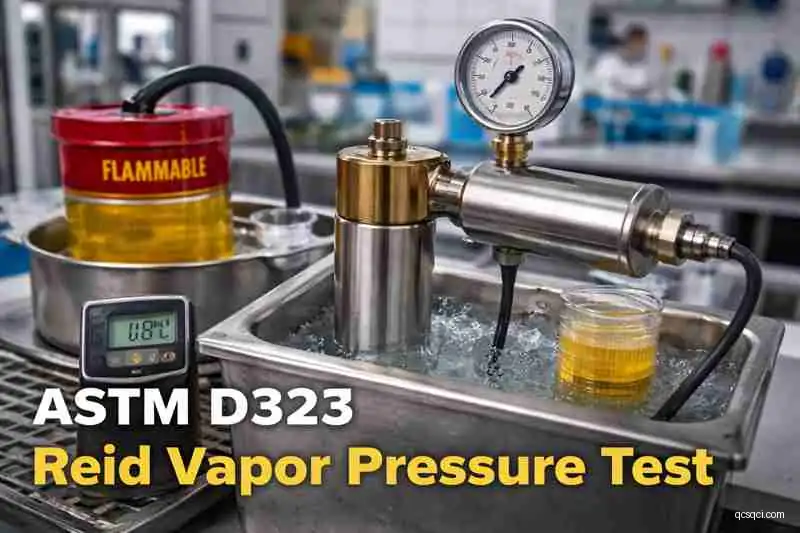
Vapor pressure is one of the most important volatility properties for petroleum products—especially gasoline. ASTM D323, commonly called the Reid Vapor Pressure (RVP) test, provides a practical, standardized way to measure vapor pressure at 37.8°C (100°F) using a dedicated liquid/vapor chamber apparatus.
This guide explains what ASTM D323 measures, when to use each procedure (A–D), the step-by-step workflow, common mistakes that cause wrong results, and FAQs—written in a clear format for lab technicians, QC inspectors, and fuel quality teams.
What is Reid Vapor Pressure (RVP)?
Reid Vapor Pressure (RVP) is the pressure developed by a chilled petroleum sample when tested in a sealed Reid apparatus and brought to equilibrium at 37.8°C (100°F). It is used as a practical indicator of volatility for gasoline, volatile crude oils, and other volatile petroleum products.
Why RVP matters
- Gasoline performance: helps predict starting behavior, warm-up performance, and vapor lock tendency.
- Quality and compliance: vapor pressure limits are often controlled in fuel specifications and environmental programs.
- Crude handling: supports decisions related to storage, transport, and initial refinery processing.
ASTM D323 applicability: Which products can you test?
ASTM D323 is used for:
- Gasoline and similar volatile petroleum products (within the method’s defined applicability)
- Volatile crude oil and other volatile petroleum products (when appropriate)
Not suitable for:
- Liquefied petroleum gases (LPG) (a different ASTM method is used)
- Certain gasoline-oxygenate blends (separate methods are commonly specified)
ASTM D323 procedures: A vs B vs C vs D (quick selection guide)
Procedure A (most common)
- For petroleum products with RVP below 180 kPa (26 psi)
- Manual operation using the classic Reid setup
Procedure B
- Also for RVP below 180 kPa (26 psi)
- Uses a horizontal bath and rotation (often improved operator consistency)
Procedure C
- For RVP above 180 kPa (26 psi)
- Modified filling/valving approach for safer and more accurate high-pressure samples
Procedure D (aviation gasoline)
- For aviation gasoline around 50 kPa (7 psi)
- Requires a tighter chamber volume ratio control than standard setups
Principle of the test (how the Reid method works)
- Chill the sample to minimize loss of light ends.
- Fill the liquid chamber with the chilled sample.
- Couple it to a vapor chamber preconditioned at 37.8°C.
- Shake/rotate in a 37.8°C bath until equilibrium pressure stabilizes.
- Read pressure, apply calibration correction, and report as RVP.
Step-by-step: ASTM D323 Procedure A (RVP < 180 kPa)
1) Sampling and handling (the most important part)
RVP is extremely sensitive to sample evaporation. To protect accuracy:
- Use proper sampling practice and airtight containers
- Keep the container filled within the specified range (commonly 70–80%)
- Cool the sample before opening (commonly 0–1°C)
- Use the first test specimen withdrawn (do not reuse leftover sample for a second RVP run)
2) Preconditioning chambers
- Chill the liquid chamber and transfer hardware in a cold bath
- Condition the vapor chamber in a bath at 37.8°C (100°F)
ASTM B571 – Standard Practice for Qualitative Adhesion Testing of Metallic Coatings
3) Sample transfer to the liquid chamber
- Transfer chilled sample into the liquid chamber to overflowing
- Prevent fire hazard: collect and dispose overflow safely
4) Assembly (speed matters)
- Couple the chambers quickly to avoid:
- air exchange
- temperature drift
- loss of light ends
5) Equilibration and pressure reading
- Immerse the assembled apparatus in a 37.8°C bath
- Perform the prescribed shaking cycles
- Take gauge readings at defined intervals
- Continue until two consecutive readings match (equilibrium)
6) Calibration check and reporting
- Verify pressure gauge reading against a reference pressure device near the observed pressure
- Apply correction (add/subtract as required)
- Report RVP to the method’s required rounding (commonly 0.25 kPa / 0.05 psi)
7) Cleaning (prevents cross-contamination)
- Thoroughly purge and rinse chambers
- Ensure the gauge and fittings are free of trapped liquid and residual sample
Procedure B overview (horizontal bath / rotating)
Procedure B follows the same fundamentals but commonly differs in practice by:
- rotating the apparatus in a horizontal bath
- reading pressure until stabilized (two consecutive equal readings)
- often using a transducer/digital readout instead of a manual gauge
This setup can reduce variability caused by shaking technique and gauge handling.
Procedure C overview (RVP > 180 kPa)
High vapor pressure materials require additional controls:
- two-opening liquid chamber with valves
- safe displacement filling methods to prevent hazards and sample loss
- faster assembly steps to reduce risk from liquid-full conditions
- pressure measurement verification may use higher-pressure calibration tools
Procedure D overview (aviation gasoline around 50 kPa)
Aviation gasoline testing demands:
- stricter vapor-to-liquid chamber volume ratio control
- additional gauge verification near the expected pressure
Common mistakes that cause incorrect RVP results
If your RVP results look inconsistent, check these first:
- Sample warmed before opening
- Evaporation during handling/transfer
- Leaks at couplings or valves
- Residual sample left in chambers (poor cleaning)
- Insufficient agitation/rotation (not reaching equilibrium)
- Gauge not checked or read incorrectly (position/tapping/verification)
- Bath temperature not stable at 37.8°C
Quality control checklist (quick)
Use this mini checklist before signing off results:
- ✅ Sample container tight, correct fill level, chilled before opening
- ✅ Liquid chamber chilled; vapor chamber conditioned at 37.8°C
- ✅ No visible leaks during test
- ✅ Bath temperature stable at 37.8°C
- ✅ Equilibrium confirmed (two consecutive identical readings)
- ✅ Gauge verified against reference device near test pressure
- ✅ Result reported with correct rounding and units
Key takeaways
- ASTM D323 RVP is a controlled equilibrium pressure measurement at 37.8°C.
- Sampling and temperature control are the biggest accuracy drivers.
- Procedure choice matters: A/B (<180 kPa), C (>180 kPa), D (aviation gasoline).
- Most “bad data” comes from evaporation losses, leaks, poor cleaning, or unstable bath temperature.
FAQs
RVP is a standardized, apparatus-based pressure at 37.8°C that can differ from true vapor pressure due to the test setup (small vaporization effects and confined gas space effects). It’s used mainly for comparability and specification control.
Because light ends evaporate easily. Warming the sample or opening it at higher temperature changes composition and causes lower or inconsistent RVP results.
When the method’s reading criteria are met—commonly two consecutive identical pressure readings after the required shaking/rotation cycles.
For best accuracy and as typically required for precision, the first withdrawn test portion is used and the remaining sample is not reused for a second RVP determination.
Use the procedure intended for samples above 180 kPa (26 psi) because the standard low-pressure approach becomes hazardous and inaccurate.