 Pritam Singh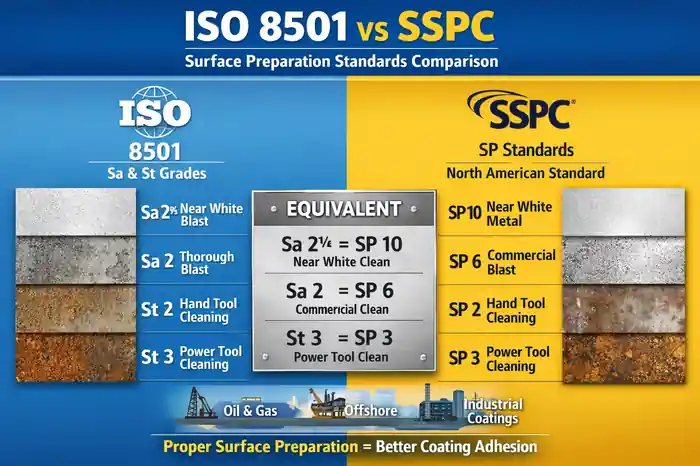
Surface preparation is one of the most important factors determining the success of any protective coating system. In industries such as oil and gas, petrochemical plants, offshore platforms, pipelines, and industrial facilities, proper surface preparation ensures that coatings adhere properly and provide long-term corrosion protection.
Many coating failures occur not because of poor coating quality but due to improper surface preparation before coating application. To avoid such problems, international organizations developed standardized methods for cleaning and preparing steel surfaces.
Two of the most widely used standards worldwide are ISO 8501 and SSPC surface preparation standards. These standards define the required cleanliness level of steel surfaces before coating application.
For coating inspectors, quality control engineers, and painting contractors, understanding the differences and equivalencies between ISO and SSPC standards is essential for ensuring compliance with project specifications.
This guide provides a detailed comparison between ISO 8501 and SSPC standards, including their cleaning grades, inspection requirements, and practical applications.
What is Surface Preparation?
Surface preparation refers to the process of cleaning and preparing metal surfaces before applying protective coatings. The goal is to remove contaminants and create a suitable surface profile that allows coatings to bond effectively.
Steel surfaces are often contaminated with substances that can affect coating performance, including:
- Rust and corrosion products
- Mill scale
- Oil and grease
- Dust and dirt
- Previous coatings
- Salts and chemical contamination
If these contaminants are not properly removed, the coating may lose adhesion, blister, or fail prematurely.
Proper surface preparation improves:
- Coating adhesion
- Durability of protective coatings
- Corrosion resistance
- Overall service life of structures
In many industrial projects, surface preparation accounts for more than 50% of coating performance.
Importance of Surface Preparation in the Oil and Gas Industry
The oil and gas industry operates in some of the most aggressive environments, including marine atmospheres, offshore platforms, and chemical plants. Steel structures in these environments are constantly exposed to moisture, salt, chemicals, and extreme weather conditions.
Without proper corrosion protection, steel structures can deteriorate rapidly, resulting in costly repairs and safety risks.
Protective coatings act as a barrier between the steel surface and the environment. However, coatings can only perform effectively when applied to properly prepared surfaces.
Therefore, international standards such as ISO 8501 and SSPC were developed to ensure that surface preparation meets specific cleanliness requirements.
These standards allow engineers and inspectors to verify that steel surfaces are prepared correctly before coating application.
Overview of ISO 8501 Surface Preparation Standard
ISO 8501 is an internationally recognized standard published by the International Organization for Standardization (ISO). It provides visual reference photographs and descriptions that help inspectors evaluate the cleanliness of steel surfaces.
ISO 8501 mainly focuses on visual surface cleanliness after blasting or mechanical cleaning.
The standard is widely used in Europe, the Middle East, Asia, and international offshore projects.
ISO 8501 is divided into several parts, but the most commonly used section is ISO 8501-1, which describes rust grades and preparation grades of steel surfaces.
Rust Grades Defined in ISO 8501
Before surface preparation begins, ISO 8501 classifies steel surfaces into four rust grades based on their initial condition.
Grade A – Steel Surface Covered with Mill Scale
This surface has mill scale that is largely intact and shows minimal rusting.
Grade B – Steel Surface with Partial Rusting
The mill scale has started to break down and rust has begun forming on the surface.
Grade C – Steel Surface with Extensive Rusting
The mill scale has mostly disappeared and the steel surface has visible corrosion.
Grade D – Steel Surface with Severe Rusting
The steel surface shows heavy rusting and pitting.
Understanding the initial rust condition helps determine the appropriate surface preparation method.
ISO 8501 Surface Preparation Grades
ISO 8501 defines several surface preparation grades depending on the cleaning method used.
Blast Cleaning Grades
Blast cleaning uses abrasive materials such as grit, garnet, or steel shot to remove contaminants from steel surfaces.
The main blast cleaning grades are:
Sa 1 – Light Blast Cleaning
Loose rust, mill scale, and paint are removed, but tightly adhered contaminants may remain.
Sa 2 – Thorough Blast Cleaning
Most mill scale, rust, and coatings are removed, but slight stains or shadows may remain.
Sa 2½ – Very Thorough Blast Cleaning
Nearly all contaminants are removed. Only slight discoloration or stains may remain.
This is the most commonly specified grade in oil and gas projects.
Sa 3 – White Metal Blast Cleaning
The surface is completely free from visible contaminants and appears metallic gray.
This provides the highest cleanliness level.
Mechanical Cleaning Grades (ISO)
In situations where abrasive blasting is not possible, mechanical tools may be used.
St 2 – Hand Tool Cleaning
Surface preparation using tools such as wire brushes and scrapers.
St 3 – Power Tool Cleaning
Cleaning using power tools such as rotary wire brushes or grinders.
Power tool cleaning generally produces better results than hand tools.
Overview of SSPC Surface Preparation Standards
The Society for Protective Coatings (SSPC) developed a series of standards widely used in North America and international industrial projects.
SSPC standards describe different surface preparation methods and assign each method a specific SP number.
These standards provide detailed instructions on how to achieve specific cleanliness levels.
Common SSPC Surface Preparation Standards
Several SSPC standards are frequently referenced in coating specifications.
SSPC-SP1 – Solvent Cleaning
Used to remove oil, grease, and soluble contaminants from steel surfaces before further cleaning.
SSPC-SP2 – Hand Tool Cleaning
Surface preparation using manual tools such as scrapers and wire brushes.
SSPC-SP3 – Power Tool Cleaning
Cleaning using power tools to remove rust and coatings.
SSPC-SP5 – White Metal Blast Cleaning
A very high level of surface cleanliness where all contaminants are removed.
SSPC-SP6 – Commercial Blast Cleaning
Most rust and mill scale are removed, but slight staining may remain.
SSPC-SP10 – Near White Metal Blast Cleaning
Almost all contaminants are removed, leaving only slight staining.
SSPC-SP11 – Power Tool Cleaning to Bare Metal
Uses power tools to produce a clean metal surface with a specified surface profile.
ISO 8501 vs SSPC Equivalent Standards
Although ISO and SSPC standards use different terminology, many grades are considered approximately equivalent.
| ISO Standard | SSPC Equivalent | Description |
|---|---|---|
| Sa 1 | SSPC-SP7 | Brush-off blast cleaning |
| Sa 2 | SSPC-SP6 | Commercial blast cleaning |
| Sa 2½ | SSPC-SP10 | Near-white metal blast cleaning |
| Sa 3 | SSPC-SP5 | White metal blast cleaning |
| St 2 | SSPC-SP2 | Hand tool cleaning |
| St 3 | SSPC-SP3 | Power tool cleaning |
Many international project specifications include both ISO and SSPC references to avoid confusion.
Key Differences Between ISO 8501 and SSPC Standards
Although both standards serve similar purposes, there are several differences.
Terminology
ISO uses the Sa and St grading system, while SSPC uses SP numbers.
Geographic Usage
ISO standards are more common in Europe, the Middle East, and Asia, while SSPC standards are widely used in North America.
Visual References
ISO standards rely heavily on photographic comparison standards, whereas SSPC standards provide more detailed procedural descriptions.
Standard Organization
SSPC standards are now part of AMPP (Association for Materials Protection and Performance) after the merger of SSPC and NACE.
Surface Preparation Inspection Procedures
Coating inspectors must verify that the required surface preparation standard has been achieved before coating application.
Inspection typically includes:
Visual Surface Cleanliness
Inspectors compare the prepared surface with reference photographs from ISO or SSPC standards.
Surface Profile Measurement
The anchor profile created by blasting is measured using instruments such as:
- Surface profile gauge
- Replica tape
Typical profile ranges are 50–75 microns for many industrial coatings.
Dust Contamination Test
Dust remaining on the surface can affect coating adhesion. Inspectors often perform a dust tape test.
Soluble Salt Testing
Salt contamination can cause coating blistering. Testing methods include Bresle test kits.
Environmental Monitoring
Before coating application, inspectors must verify:
- Air temperature
- Surface temperature
- Relative humidity
- Dew point
Environmental conditions must meet specification requirements.
Practical Applications of ISO and SSPC Standards
Surface preparation standards are used in many industries, including:
- Offshore platforms
- Oil and gas pipelines
- Storage tanks
- Petrochemical plants
- Shipbuilding
- Bridges and infrastructure
For example, offshore platforms exposed to marine environments typically require Sa 2½ or SSPC-SP10 blast cleaning before coating.
Common Problems Caused by Poor Surface Preparation
Improper surface preparation can lead to several coating failures, including:
- Coating blistering
- Rust breakthrough
- Coating delamination
- Reduced coating life
- Increased maintenance costs
Many coating failures occur within the first few years of service due to inadequate surface preparation.
Best Practices for Surface Preparation
To achieve the best results, the following practices should be followed:
- Remove oil and grease before blasting
- Use appropriate abrasive materials
- Maintain proper blasting pressure
- Ensure correct surface profile
- Inspect surfaces immediately before coating
Proper quality control helps ensure that the coating system performs as intended.
Conclusion
Surface preparation is a critical step in the application of protective coatings. International standards such as ISO 8501 and SSPC surface preparation standards provide clear guidelines for achieving the required level of steel cleanliness before coating.
Although the two standards use different classification systems, they serve the same purpose: ensuring that steel surfaces are properly cleaned and prepared to maximize coating performance.
For coating inspectors, engineers, and contractors working in industries such as oil and gas, offshore construction, and industrial infrastructure, understanding the relationship between ISO and SSPC standards is essential for maintaining quality and preventing corrosion-related failures.
By following these standards and performing proper inspection procedures, organizations can significantly extend the service life of their structures and reduce long-term maintenance costs.
Frequently Asked Questions (FAQ)
ISO 8501 is an international standard that defines the cleanliness levels of steel surfaces before coating application. It provides visual reference photographs and descriptions for different surface preparation grades such as Sa 1, Sa 2, Sa 2½, Sa 3, St 2, and St 3. These grades help inspectors evaluate whether a steel surface is properly cleaned before applying protective coatings.
The main difference between ISO 8501 and SSPC standards is the classification system used to define surface cleanliness. ISO 8501 uses Sa and St grades, while SSPC standards use SP numbers. For example, ISO Sa 2½ is equivalent to SSPC-SP10, which represents near-white metal blast cleaning.
Sa 2½ is a very thorough blast cleaning grade defined in ISO 8501. It requires that nearly all rust, mill scale, coatings, and contaminants are removed from the steel surface. Only slight stains or discoloration may remain. This grade is widely used in oil and gas, offshore structures, and industrial coating projects.
SSPC-SP10 is a surface preparation standard developed by the Society for Protective Coatings. It requires that at least 95% of the steel surface must be free of visible contaminants, leaving only slight staining. This standard is commonly specified for high-performance coating systems.
The equivalent of ISO Sa 2½ in SSPC standards is SSPC-SP10 Near White Metal Blast Cleaning. Both standards require a very high level of surface cleanliness and are commonly specified in industrial coating applications.
Surface preparation is important because it removes contaminants such as rust, mill scale, oil, and dust that can prevent coatings from properly adhering to steel surfaces. Proper surface preparation improves coating adhesion, corrosion resistance, and overall durability.
Blast cleaning uses abrasive materials such as garnet, steel grit, or sand to remove contaminants from steel surfaces. Power tool cleaning uses mechanical tools like grinders and wire brushes. Blast cleaning usually provides better surface cleanliness and profile compared to power tool cleaning.
Both ISO 8501 and SSPC standards are widely used in oil and gas projects. Many international specifications include both standards together to ensure compatibility between different contractors and inspection teams.