 By admin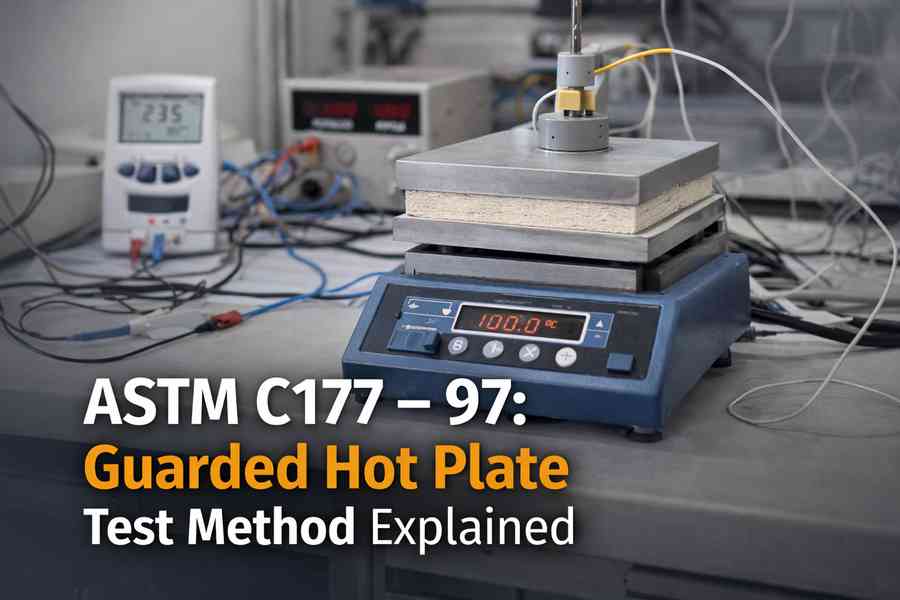
Introduction
ASTM C177 – 97 is a widely recognized standard test method for measuring steady-state heat flux and thermal transmission properties using the Guarded Hot Plate (GHP) apparatus. This primary (absolute) method is essential for determining the thermal conductivity, thermal resistance, and thermal conductance of insulation materials and other construction products.
In industries such as oil & gas, building construction, industrial insulation, and cryogenic systems, accurate thermal testing ensures energy efficiency, process stability, and long-term asset protection.
What Is ASTM C177?
ASTM C177 – 97 establishes laboratory procedures for measuring steady-state heat transfer through flat, homogeneous specimens placed between controlled hot and cold surfaces.
It is:
- A primary (absolute) test method
- Comparable to ISO 8302
- Suitable for a wide range of materials including:
- Thermal insulation boards
- Fibrous insulation
- Rigid foam
- Porous materials
- Transparent materials
- High-temperature refractory insulation
Scope of ASTM C177
The standard applies to:
- Flat, homogeneous specimens
- Single-sided or double-sided test modes
- Vertical or horizontal heat flow configurations
- Measurements under different gases and pressures
- Wide temperature ranges, including high and cryogenic temperatures
However, it is not suitable for systems with thermal bridges or significant inhomogeneity in the heat flow direction.
How the Guarded Hot Plate Apparatus Works
The Guarded Hot Plate (GHP) apparatus consists of:
- Hot Surface Assembly
- Metered section heater
- Primary guard heater
- Two Cold Surface Assemblies
- Maintain constant temperature
- Specimen
- Placed between hot and cold plates
- Secondary Guard & Edge Insulation
- Minimize lateral heat loss
The goal is to achieve one-dimensional steady-state heat flow through the specimen.
Key Measured Parameters:
- Heat flow rate (Q)
- Heat flux (q)
- Temperature difference (ΔT)
- Specimen thickness (L)
- Metered section area (A)
From these values, thermal properties are calculated.
Thermal Properties Determined
ASTM C177 allows calculation of:
- Thermal Conductivity (λ) – W/m·K
- Thermal Resistance (R-value) – m²·K/W
- Thermal Conductance (C-value) – W/m²·K
- Thermal Resistivity
These values are critical in:
- Building envelope performance
- Industrial insulation design
- Pipeline insulation systems
- Offshore and onshore process facilities
For detailed calculation methodology, refer to ASTM Practice C1045.
Why ASTM C177 Is Important
1. High Accuracy
It is considered an absolute method, meaning it does not rely on calibration against another material.
2. Reference Standard
Other comparative methods like ASTM C518 depend on reference materials validated using ASTM C177.
3. Essential for Insulation Testing
Used globally for:
- Energy efficiency certification
- HVAC system performance
- Cryogenic insulation testing
- Fireproofing system verification
Limitations of ASTM C177
While highly accurate, this method has practical limitations:
- Long stabilization time (hours or days)
- Not ideal for highly inhomogeneous materials
- Requires careful control of:
- Edge heat losses
- Gap imbalance
- Surface contact resistance
- Specimen thickness measurement
Compliance & Reporting Requirements
A compliant test report must include:
- Specimen identification
- Density and thickness
- Mean temperature
- Temperature difference
- Heat flux
- Calculated thermal properties
- Measurement uncertainty
- Environmental conditions
Proper uncertainty estimation should follow ISO guidelines such as ISO Guide to the Expression of Uncertainty in Measurement.
Applications in Industry
ASTM C177 is commonly used in:
- Oil & gas insulation systems
- LNG and cryogenic plants
- Industrial furnace linings
- Building insulation certification
- Offshore platform insulation
For official documentation or to purchase the standard, visit the ASTM International website:
👉 https://www.astm.org/
Conclusion
ASTM C177 – 97 remains one of the most authoritative standards for measuring steady-state heat flux and thermal conductivity using the Guarded Hot Plate apparatus. Its high accuracy and comprehensive methodology make it essential for laboratories, insulation manufacturers, and quality control engineers.
When implemented correctly, it ensures reliable thermal performance data for design, compliance, and certification purposes.