 By Admin
By Pritam Singh, QC Coating Inspector
Weld areas are the most vulnerable locations in any steel structure. No matter how good the coating system is, if welds, edges, and sharp corners are not properly protected, coating failure will start from these points first.
That is why stripe coating is mandatory in most oil & gas, tank, pipeline, and structural steel projects.
In this article, I will explain:
- What stripe coating is
- Why weld areas need special attention
- When to apply stripe coat
- Inspection requirements
- Common mistakes in field
- Relevant ASTM/industry references
What is Stripe Coating?
Stripe coating is the manual application of paint (usually by brush) on critical areas before or between full spray coats to ensure adequate film build.
It is applied on:
- Weld seams
- Edges and corners
- Bolts and nuts
- Cut-outs and penetrations
- Complex geometry areas
- Back-to-back angles
- Stiffeners and brackets
Stripe coat is not an extra cosmetic layer — it is a preventive corrosion control practice.
Why Weld Areas Need Stripe Coating
1️⃣ Weld Geometry Creates Thin Film Areas
When spraying paint:
- Sharp edges receive lower film thickness
- Spray fan does not deposit evenly on corners
- Weld beads create irregular surfaces
This results in:
❌ Lower DFT at weld toe
❌ Pinholes and micro voids
❌ Early rusting
Stripe coating ensures the weld toe and edge receive sufficient film thickness.
2️⃣ Weld Areas Have Higher Corrosion Risk
Weld zones may have:
- Slag inclusions
- Undercut areas
- Rough profile
- Heat-affected zone (HAZ)
These areas are more reactive and prone to corrosion if not properly coated.
3️⃣ Spray Application Alone is Not Enough
Even with proper DFT control (ASTM D7091), weld toes often show:
- 20–40% lower thickness than flat surfaces
This is why most specifications require:
✔ Stripe coat before intermediate coat
✔ Stripe coat before top coat
✔ Sometimes double stripe coat for immersion service
When Should Stripe Coating Be Applied?
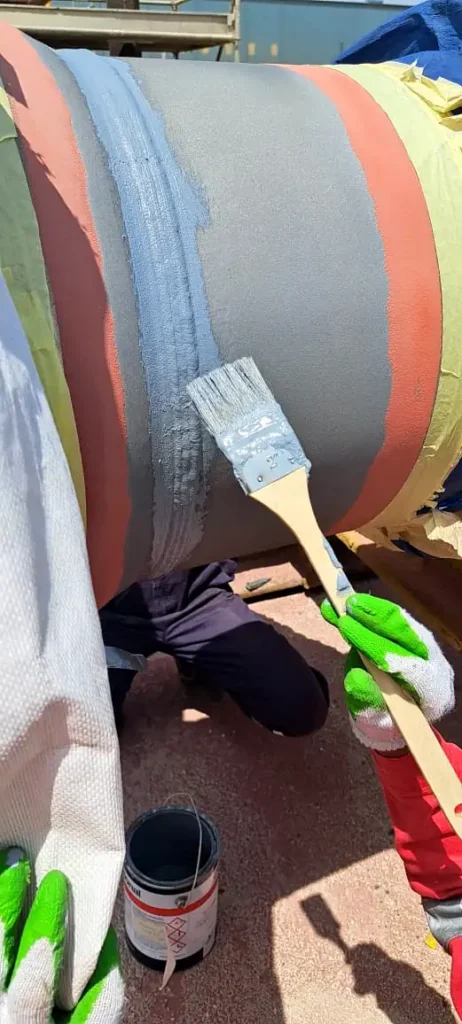
Stripe coating is normally applied:
✔ After Surface Preparation
After blasting and inspection (cleanliness + profile verified)
✔ Before Full Spray Coat
Apply stripe coat by brush on welds and edges
✔ Between Coats (If Specified)
Some projects require:
- Stripe coat on primer
- Stripe coat on intermediate
- Stripe coat on final lining system
Always follow project specification and coating manufacturer’s TDS.
How to Apply Stripe Coat Properly
Step 1 – Surface Must Be Clean
- Surface preparation verified
- Dust removed
- No moisture
Complete Surface Preparation Inspection Checklist for Oil & Gas Projects
Step 2 – Use Brush Application
Stripe coat must be:
- Applied by brush (not spray)
- Worked into weld toes and corners
- Applied uniformly (no excessive build or runs)
Step 3 – Respect Recoat Window
Apply full spray coat:
- Within manufacturer’s recoat window
- Not after overcoating interval
Inspection Requirements for Stripe Coating
As a QC Inspector, I check:
✔ Visual confirmation of stripe coverage
✔ No missed weld areas
✔ No excessive build leading to runs
✔ Proper curing before next coat
✔ DFT verification after full system
Relevant references commonly used in inspection:
- ASTM D3276 – Painting Inspector Guide
- ASTM D7091 – Dry Film Thickness Measurement
- SSPC-PA 2 – DFT acceptance criteria
Common Mistakes in Field
❌ Skipping stripe coat to save time
❌ Spraying instead of brushing
❌ Applying stripe coat after final coat
❌ Not checking weld toes carefully
❌ Applying stripe coat outside recoat window
❌ Excessive thick stripe leading to cracking
These mistakes often lead to:
- Rusting at weld toe within months
- Premature coating failure
- Client rejection
Stripe Coating in Tank Internal Systems
For tank linings and immersion service:
Stripe coating is even more critical because:
- Pinholes in welds can cause rapid corrosion
- Immersion service requires zero holidays
After final coat, discontinuity testing should be performed.
Holiday Test in Painting: Definition, Types, and Importance
Why Stripe Coating Extends Coating Life
Studies and field experience show:
Most coating failures begin at:
- Weld seams
- Edges
- Bolted joints
Proper stripe coating:
✔ Increases edge film build
✔ Reduces holiday formation
✔ Improves long-term corrosion resistance
✔ Reduces maintenance cost
It is a small step that provides major durability improvement.
Best Practice Recommendation
From my 11 years of coating inspection experience:
For atmospheric systems:
✔ Minimum one stripe coat on welds and edges
For marine exposure:
✔ Stripe coat on primer and intermediate
For immersion/tank lining:
✔ Stripe coat on every coat layer
FAQ
In most oil & gas and industrial projects — yes. It is typically required by project specifications.
No. Stripe coat should be applied by brush to ensure penetration into weld toes and corners.
Normally it is included in total system DFT, but excessive build must be avoided.
Weld areas may rust early, causing premature coating failure.
Usually not in the same way as liquid coatings, but edge protection is still important.