 By admin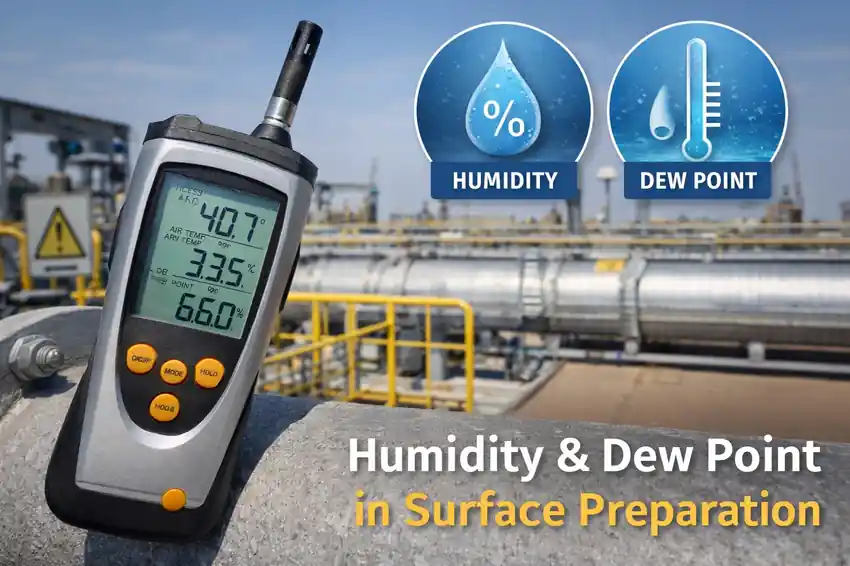
By Pritam Singh, QC Coating Inspector
In my 11 years of coating inspection experience in oil & gas projects, I have seen many blasting jobs rejected — not because of poor workmanship — but because environmental conditions were ignored.
Humidity and dew point control are critical during surface preparation. If we blast steel under wrong atmospheric conditions, corrosion can start immediately — even before primer application.
This article explains how humidity and dew point affect surface preparation, and how I control them in the field.
Why Environmental Conditions Matter
After blasting, steel becomes highly reactive. The clean surface has no protective oxide layer, so it starts oxidizing immediately when exposed to moisture.
If environmental conditions are not controlled, the following can occur:
- Flash rusting
- Salt contamination activation
- Surface condensation
- Coating adhesion failure
Surface preparation is not complete unless environmental conditions are acceptable.
Understanding Relative Humidity (RH)
Relative Humidity (RH) is the percentage of moisture in the air compared to the maximum amount the air can hold at that temperature.
Example:
- 85% RH means air contains 85% of its moisture capacity.
Why High RH Is Dangerous
When RH is high:
- Moisture forms faster on steel
- Flash rust develops quickly
- Time window before coating reduces
- Surface contamination becomes active
Most specifications limit RH to:
✔ Below 85% (common requirement)
✔ Sometimes below 80% for critical coating systems
Always check project specification.
What Is Dew Point?
Dew point is the temperature at which air becomes saturated and moisture begins to condense.
When steel temperature falls to or near dew point:
👉 Condensation forms on the surface.
👉 Invisible moisture film may develop.
👉 Coating adhesion can fail.
The 3°C Rule (Very Important)
In almost all oil & gas projects, the requirement is:
Steel surface temperature must be at least 3°C above dew point temperature.
This is critical to prevent condensation.
If steel temperature is less than 3°C above dew point:
❌ Blasting must stop
❌ Coating must not be applied
How Dew Point Affects Surface Preparation
1️⃣ Flash Rusting After Blasting
Blasted steel is highly active. If humidity is high:
- Light flash rust can form within minutes
- Moderate rust can develop within hours
- Heavy rust may require re-blasting
This increases cost and delays schedule.
2️⃣ Hidden Condensation
Sometimes the surface looks dry but a microscopic moisture layer exists.
This leads to:
- Poor primer wetting
- Blistering
- Underfilm corrosion
3️⃣ Salt Activation
If chlorides are present:
- High humidity increases corrosion rate
- Salts absorb moisture from air
- Corrosion begins under coating
That is why salt testing is often required before coating.
How I Control Environmental Conditions in the Field
Before blasting or coating, I measure:
✔ Air temperature
✔ Steel surface temperature
✔ Relative humidity
✔ Dew point
Using a calibrated digital hygrometer or psychrometer.
My Field Procedure
Step 1: Record Environmental Data
Document:
- Date and time
- Location
- Instrument ID
- Calibration validity
Step 2: Verify 3°C Rule
Confirm:
Steel Temp ≥ Dew Point + 3°C
If not compliant:
- Stop blasting
- Delay coating
- Re-check every 30–60 minutes
Step 3: Monitor During Work
Conditions change during:
- Morning to afternoon
- Sunset
- Sudden weather change
Environmental readings must be taken:
✔ Before blasting
✔ Before coating
✔ During coating (periodically)
When Problems Usually Occur
From my experience, issues commonly occur:
- Early morning (high humidity)
- Late evening
- During marine operations
- After sudden temperature drop
Inspectors must remain alert during these periods.
Practical Example From Site
In one project, blasting was completed at 5 PM. Primer application was delayed until 8 PM.
During that time:
- Temperature dropped
- Dew point approached steel temperature
Result:
- Light flash rust formed
- Entire area required re-blasting
This could have been avoided with proper monitoring.
Environmental monitoring requirements are guided by industry standards from organizations such as AMPP (formerly NACE/SSPC), which emphasize dew point control and proper atmospheric conditions before coating application.
Common Mistakes in Environmental Control
❌ Taking reading only once per day
❌ Ignoring steel temperature
❌ Using uncalibrated instrument
❌ Assuming “weather looks fine”
❌ Ignoring sudden humidity increase
Environmental control is not optional — it is mandatory.
Best Practices for Surface Preparation Under Humid Conditions
✔ Blast during stable daytime conditions
✔ Avoid blasting late afternoon if coating is delayed
✔ Use dehumidification units in critical areas
✔ Cover blasted surfaces if coating is delayed
✔ Prime as soon as possible after blasting
Conclusion
Humidity and dew point directly affect surface preparation quality. Even perfect blasting can fail if environmental conditions are not controlled.
As inspectors, we must ensure:
- RH is within specification
- Steel temperature is at least 3°C above dew point
- No condensation forms
- Flash rust is avoided
In my experience, controlling environment is as important as controlling surface profile.
Surface preparation is not complete until environmental conditions are verified and documented.
FAQ
Condensation forms, leading to coating adhesion failure.
It prevents moisture condensation on steel surface.
It depends on specification, but generally RH above 85% is not recommended.
Before blasting, before coating, and periodically during application.
Yes. Higher humidity significantly increases flash rust rate.