 By Admin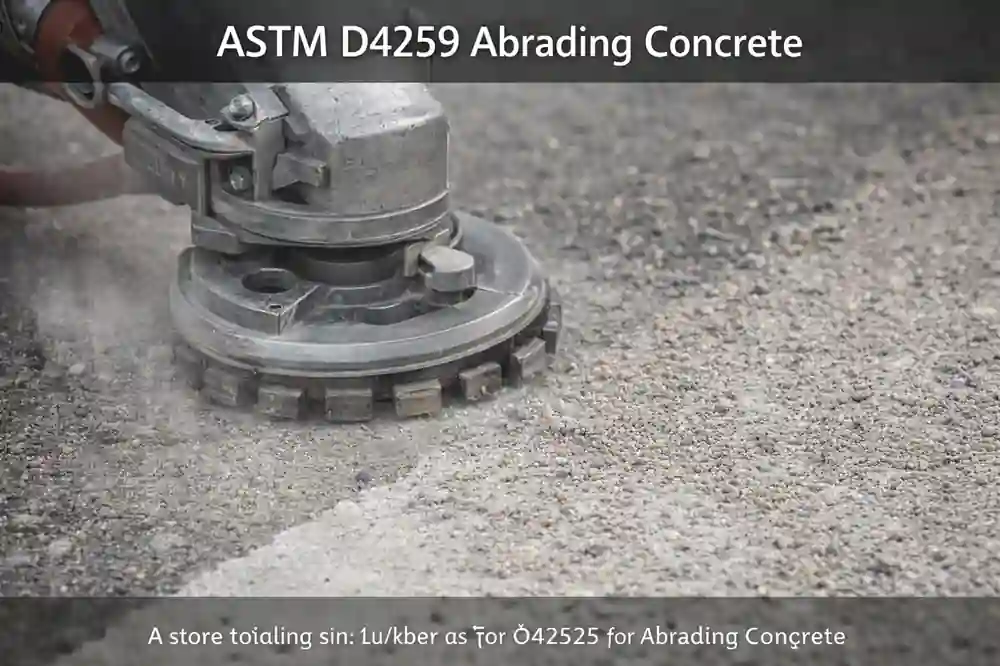
Introduction
Concrete surface preparation directly affects coating performance. In heavy-duty industrial environments, simple cleaning is not enough. The concrete surface must be mechanically roughened to ensure strong adhesion between the substrate and the protective coating system.
ASTM D4259 provides standardized procedures for abrading concrete surfaces prior to coating application. This standard is widely used in industrial flooring, wastewater facilities, oil & gas plants, power generation facilities, and immersion service environments.
Unlike basic cleaning standards, ASTM D4259 is specifically designed to alter the concrete surface profile, remove weak laitance, and create a roughened texture that promotes optimal coating bond strength.
What Is ASTM D4259?
ASTM D4259 is a standard practice for mechanical surface preparation of concrete.
Its purpose is to:
✔ Remove weak surface laitance
✔ Eliminate curing compounds and release agents
✔ Remove oil and grease contamination
✔ Create a roughened surface profile
✔ Improve long-term coating adhesion
This practice is used where strong mechanical bonding is required.
When Should ASTM D4259 Be Used?
Use ASTM D4259 when:
- Coatings will be exposed to continuous or intermittent immersion
- Mechanical loading is expected
- Thermal cycling occurs
- High-performance epoxy or polyurethane systems are applied
- Long-term durability is critical
It is commonly required in:
- Refineries
- Offshore platforms
- Tank foundations
- Secondary containment areas
- Wastewater treatment plants
Difference Between ASTM D4258 and ASTM D4259
| ASTM D4258 | ASTM D4259 |
|---|---|
| Cleans concrete surface | Abrades and roughens surface |
| Does not change profile | Alters surface profile |
| Light-duty preparation | Heavy-duty preparation |
| Removes surface contamination | Removes laitance and creates texture |
ASTM D4259 preparation typically requires prior cleaning according to ASTM D4258.
Acceptable Surface Preparation Methods
ASTM D4259 allows multiple mechanical methods.
1️⃣ Mechanical Abrading
Suitable For:
- Formed concrete surfaces
- Industrial floors
- Removal of fins and projections
Equipment Includes:
- Rotary impact tools
- Vertical impact equipment
- Grinding machines
Objective:
- Remove weak surface layers
- Expose sound concrete
- Create textured profile
Some aggregate exposure is acceptable.
2️⃣ Water Blast Cleaning
Equipment:
- High-pressure positive displacement pump
- Potable water
Purpose:
- Remove laitance
- Remove efflorescence
- Roughen the surface
Oil and grease must be removed first using ASTM D4258 procedures.
3️⃣ Abrasive Blast Cleaning
Methods:
- Wet abrasive blasting
- Dry abrasive blasting
- Recirculating blast systems
Compressed air must be oil-free (verify using ASTM D4285).
Expected Result:
- Roughened texture
- Opened bug holes
- Removal of curing compounds
- Exposed sound substrate
Common Sandblasting Defects and How to Avoid Them
Surface Appearance Requirements
After preparation, the surface must:
✔ Be free of laitance
✔ Be free of oil and grease
✔ Be free of curing compounds
✔ Be free of loose particles
✔ Have a roughened, textured appearance
✔ Possibly expose aggregate
A roughness standard may be agreed upon by project stakeholders.
Inspection Requirements
Inspection includes:
- Visual examination for contamination
- Checking for loose concrete
- Verifying removal of projections
- Optional pull-off adhesion testing per ASTM D4541
Surface strength requirements may apply for critical systems.
Concrete Curing Requirement
New concrete must be cured according to ACI 308 before abrading.
Improper curing can reduce coating bond strength.
Post-Preparation Cleaning
After abrading, clean the surface in accordance with ASTM D4258 to remove dust and loose debris before coating application.
Practical Field Example
Tank containment slab preparation:
- Concrete cured properly
- Oil contamination removed
- Abrasive blasting performed
- Surface visually inspected
- Dust removed
- Epoxy lining applied
This ensures optimal adhesion performance.
FAQ Section
Yes. It is specifically intended to roughen the surface for better coating adhesion.
Yes. Mechanical profiling is strongly recommended for immersion systems.
Laitance is a weak cement layer on the surface of concrete that reduces coating adhesion.
Yes. Partial aggregate exposure is often desirable for improved bonding.
Conclusion
ASTM D4259 plays a vital role in ensuring coating performance on concrete substrates in demanding industrial environments. By mechanically abrading the surface, this standard removes weak layers, enhances surface roughness, and significantly improves coating adhesion.
For high-performance protective systems — especially in oil & gas, wastewater, and heavy industrial applications — following ASTM D4259 is essential for long-term durability and reduced failure risk.
When combined with proper cleaning, curing, and inspection procedures, ASTM D4259 helps create a foundation for reliable and long-lasting coating performance.