 By Admin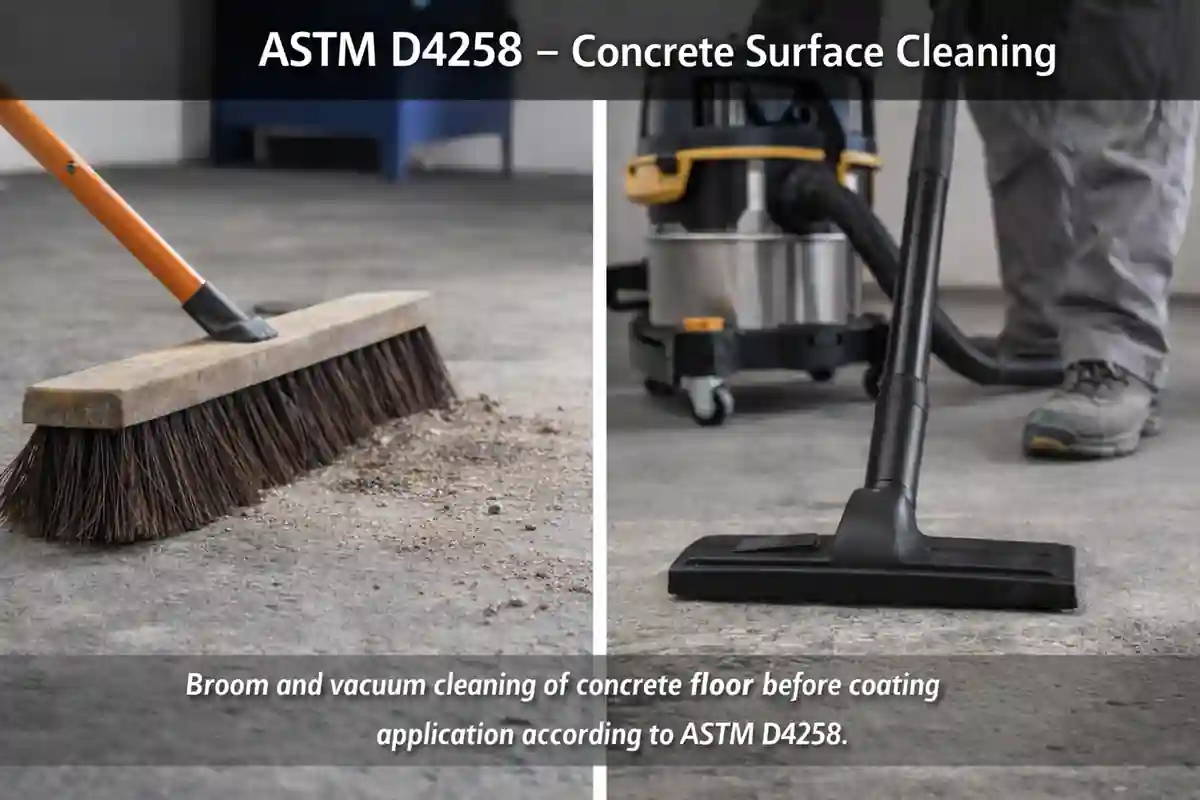
What is ASTM D4258?
ASTM D4258 is a standard practice for cleaning concrete surfaces before applying protective coatings.
It explains how to remove:
- Oil
- Grease
- Dust
- Dirt
- Loose concrete
- Surface contamination
⚠ This standard only focuses on cleaning.
It does not change the surface profile of concrete.
Why Is Concrete Surface Cleaning Important?
If concrete is not properly cleaned:
- Coating may not stick properly
- Blistering can occur
- Peeling or delamination may happen
- Coating life will reduce
Cleaning ensures good adhesion and long-term coating performance.
When Should ASTM D4258 Be Used?
Use ASTM D4258 when:
- Applying light-duty coatings
- Surface profile is already acceptable
- No immersion service is required
- No heavy mechanical load is expected
For heavy-duty or immersion service, use:
- ASTM D4259 (mechanical abrasion)
- ASTM D4260 (acid etching)
Cleaning Methods Allowed Under ASTM D4258
You can use one method or a combination.
1. Broom Cleaning
Purpose: Remove loose dust and debris.
- Use stiff industrial broom
- Sweep entire area
- Remove sweepings
Usually followed by another cleaning method.
2. Vacuum Cleaning
Purpose: Remove fine dust.
- Use industrial vacuum
- Achieve dust-free surface
Recommended after air blast cleaning.
3. Air Blast Cleaning
Purpose: Remove dust from walls and ceilings.
- Use compressed air (80–100 psi)
- Nozzle 2 ft away from surface
- Air must be oil-free (check using ASTM D4285)
Dust must not redeposit on surface.
4. Water Cleaning
Purpose: Remove water-soluble contaminants.
- Use clean potable water
- Scrub if required
- Ensure proper drainage
Moisture can be tested using ASTM D4263.
5. Detergent Water Cleaning
Purpose: Remove oil and grease.
- Scrape heavy deposits
- Wash with detergent solution
- Rinse thoroughly
- Repeat until water does not bead
Check pH using ASTM D4262.
6. Steam Cleaning
Purpose: Remove heavy grease contamination.
- Use high-pressure steam
- May use emulsifying agents
- Rinse before surface dries
- Test pH and moisture before coating
Important Safety & Quality Checks
1. Concrete Curing
New concrete must be cured properly (see ACI 308).
2. Moisture Content
Excess moisture can cause coating failure.
3. Cure Compounds
Some cure compounds must be removed by mechanical methods.
Inspection After Cleaning
Surface must be:
✔ Free of oil
✔ Free of grease
✔ Free of dust
✔ Free of loose material
✔ Free of contamination
If detergents are used:
- Check pH
- Check moisture
What ASTM D4258 Does NOT Do
- Does not create surface profile
- Does not roughen concrete
- Does not remove hard contaminants
- Not suitable for immersion systems
Simple Field Example
Industrial warehouse floor:
- Broom cleaning
- Vacuum cleaning
- Detergent washing for oil spots
- Moisture test
- Apply epoxy coating
If heavy-duty system → mechanical abrasion required.
FAQ
No. It only cleans the surface. It does not alter the profile.
No. Immersion systems require mechanical preparation such as ASTM D4259 or acid etching.
Moisture can cause blistering and adhesion failure.
Yes. Improper rinsing can leave residues that reduce bond strength.