 By admin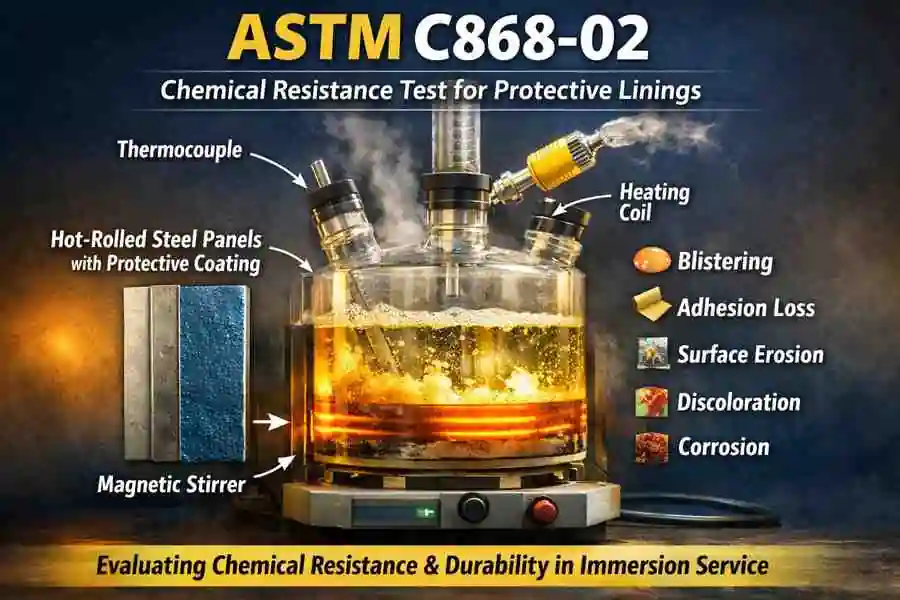
Introduction
ASTM C868 – 02 is a standard test method used to evaluate the chemical resistance of protective linings under immersion service conditions. This method closely simulates real industrial environments by creating a temperature differential between the exposed and unexposed sides of a coated panel — accelerating potential permeation, blistering, delamination, and substrate corrosion.
It is widely used in oil & gas, petrochemical plants, water treatment facilities, and industrial storage tanks where corrosion-resistant coatings are critical.
What Is ASTM C868?
ASTM C868 specifies laboratory procedures for assessing the durability and chemical resistance of polymer-based protective linings when exposed to corrosive media under controlled conditions.
The test helps determine:
- Resistance to corrosive chemicals
- Lining adhesion performance
- Blistering and permeation behavior
- Surface degradation and hardness changes
- Substrate corrosion protection
This method is intended as a qualitative evaluation tool, not the sole basis for material selection.
Scope of ASTM C868
The test method:
- Simulates immersion service conditions
- Applies temperature control (±2°C)
- Evaluates coating performance over 1 to 6 months (or longer)
- Uses steel test panels prepared to White Metal standard
The substrate preparation follows:
NACE No. 1/SSPC-SP-5 — White Metal Blast Cleaning.
Apparatus Used in ASTM C868
The primary equipment includes:
1️⃣ Four-Neck Borosilicate Glass Test Cell
- Cylindrical chemical-resistant glass cell
- Allows heater, thermometer, condenser, and gas bubbler installation
2️⃣ Heating Equipment
- Electrical immersion heater
- External heating tape (must not contact test panel)
- Controlled to ±4°F (±2°C)
3️⃣ Reflux Water Condenser
Maintains constant solution concentration and prevents evaporation loss.
4️⃣ Air or Gas Bubbler
- Used for agitation and temperature uniformity
- Nitrogen for oxygen-depleted simulations
- Air bubbling for aerated service conditions
ASTM B571 – Standard Practice for Qualitative Adhesion Testing of Metallic Coatings
Test Specimen Requirements
Substrate
- 1/4 in. carbon steel panels
- Prepared to White Metal condition
- Profile depth measured per ASTM D4417
Lining Application
- Applied as per manufacturer’s field method (spray, roller, etc.)
- Thickness within ±10% of nominal
- Opposite side remains unlined
Conditioning
- 7 days at 23 ± 2°C
- Additional curing if specified
Test Procedure Overview
- Clamp coated panel to glass cell
- Fill 2/3–3/4 with specified chemical solution
- Maintain required temperature
- Inspect at monthly intervals
- Refill fresh solution after each inspection
- Continue exposure for 6 months or until failure
Evaluation Criteria
Interim Inspection
- Color change
- Gloss reduction
- Surface erosion
- Blistering (per ASTM D714)
- Media changes
Final Inspection (After 6 Months)
- Hardness testing (D785, D1474, D2583, D3363)
- Adhesion testing (D4541 pull-off method)
- Substrate corrosion check
- Microscopic examination (if required)
⚠ High-voltage holiday testing is not permitted after exposure.
Significance in Oil & Gas & Industrial Coating Inspection
For coating inspectors like you, Pritam, this test is extremely relevant when selecting:
- Tank linings
- Chemical process equipment coatings
- Wastewater treatment linings
- Acid storage protective systems
- FRP lining systems
The results help verify long-term durability under aggressive chemical environments.
For official purchase or latest revision updates, visit:
👉 https://www.astm.org/
Advantages of ASTM C868
✔ Simulates real immersion service
✔ Accelerates permeation effects
✔ Evaluates adhesion & blister formation
✔ Applicable to multiple substrates
✔ Long-term durability assessment
Limitations
- Qualitative evaluation
- Subjective visual assessment
- Long exposure period required
- Requires strict temperature control
✅ Frequently Asked Questions (FAQ)
ASTM C868-02 is a standard test method used to evaluate the chemical resistance of polymer-based protective linings under immersion service conditions. It simulates real field exposure, including temperature differentials that may accelerate permeation and degradation.
ASTM C868 evaluates coating performance under chemical immersion by observing:
Blistering
Discoloration
Gloss reduction
Surface erosion
Adhesion loss
Hardness changes
Substrate corrosion
The test provides a qualitative assessment of long-term lining durability.
ASTM C868 simulates immersion service conditions for protective linings on panels, including temperature differential effects.
ASTM C267 is generally used as a simpler prescreening chemical resistance test for mortars, polymer concretes, and similar materials.