 By admin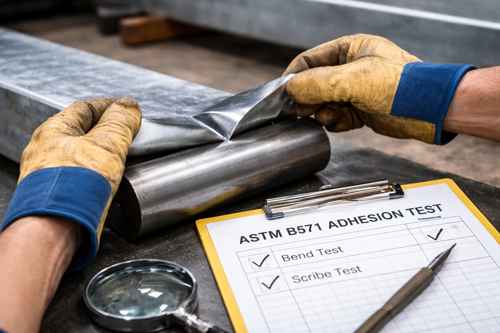
ASTM B571 – Standard Practice for Qualitative Adhesion Testing of Metallic Coatings provides simple, practical methods to evaluate the adhesion of metallic coatings to substrates. These tests are widely used in production control, acceptance inspection, plating quality control, and coating failure analysis.
Unlike quantitative pull-off tests, ASTM B571 focuses on qualitative evaluation, helping inspectors determine whether adhesion is satisfactory or not.
1️⃣ Purpose and Significance
ASTM B571 is used to:
- Detect poor bonding between coating and substrate
- Verify plating quality in production
- Support acceptance testing
- Evaluate coating performance after heat treatment or forming
The standard emphasizes that:
If more than one adhesion test is specified, failure of any one test means the coating is unacceptable.
2️⃣ What is “Perfect Adhesion”?
Perfect adhesion exists when:
- Bond strength between coating and substrate
- Is greater than the cohesive strength of either material
In practical inspection terms:
If the coating peels, flakes, lifts, or separates, adhesion is not satisfactory.
3️⃣ Common Adhesion Test Methods in ASTM B571
The standard includes multiple qualitative adhesion tests. Selection depends on:
- Coating type
- Thickness
- Ductility
- Substrate material
- End-use requirements
Below are the main test methods:
🔹 1. Bend Test
Used for ductile coatings.
Procedure:
- Bend sample over a mandrel (diameter = 4× sample thickness)
- Inspect at low magnification
- Look for peeling or flaking
- Cracking alone does not indicate failure unless coating lifts
Best for: Parts that will be formed or bent in service.
🔹 2. Burnishing Test
- Rub coating with smooth steel tool (about 15 seconds)
- Look for blistering or lifting
Not suitable for thick coatings.
🔹 3. Chisel/Knife Test
- Penetrate coating with sharp chisel or blade
- Attempt to lift coating
If coating detaches → adhesion is poor.
Not suitable for thin or soft coatings.
ASTM A123/A123M Hot-Dip Galvanizing Standard: Coating Thickness, Inspection & Acceptance
🔹 4. Draw Test
- Form coated sample into a deep-drawn cap
- Inspect for peeling or flaking
Useful for components subjected to forming operations.
🔹 5. File Test
- Saw through coated specimen
- File edge from substrate toward coating
- Observe lifting or peeling
Not recommended for thin or soft coatings.
🔹 6. Grind-Saw Test
- Grind or saw from substrate toward coating
- Observe for separation
Effective for brittle coatings.
🔹 7. Heat-Quench Test
Procedure:
- Heat coated article to specified temperature
- Maintain within ±10°C
- Quench in room-temperature water
- Inspect for peeling or flaking
Blisters alone are not always adhesion failure.
Useful for:
- Parts exposed to heat
- Plated parts requiring baking
🔹 8. Impact Test
- Apply controlled mechanical impact
- Inspect indentation area for blistering or exfoliation
Difficult to interpret for soft coatings.
🔹 9. Peel Test
- Bond strip or tape to coating
- Pull at 90°
- Separation at interface = failure
Requires standardized pull rate and dimensions.
🔹 10. Push Test
- Drill blind hole near interface
- Push out button sample
- Inspect for exfoliation
Not suitable for thin coatings.
🔹 11. Scribe-Grid Test (Cross Hatch Test)
Procedure:
- Scribe parallel lines or grid pattern
- Apply pressure-sensitive tape
- Pull tape rapidly at 180°
If coating between grid lines detaches → adhesion inadequate.
Commonly used in quality control.
4️⃣ Important Interpretation Notes
- These are qualitative tests (no numeric adhesion value).
- Results may vary depending on coating thickness and ductility.
- Agreement must be reached between parties on acceptable results.
- When used for acceptance inspection, test method must be specified in contract.
5️⃣ When to Perform Adhesion Testing
Adhesion testing is recommended:
✔ After plating
✔ After heat treatment
✔ After forming
✔ During production control
✔ For customer acceptance
ASTM B571 vs Other Adhesion Standards
| ASTM B571 | ISO 2409 | ASTM D3359 |
|---|---|---|
| Metallic coatings | Paint coatings | Paint coatings |
| Qualitative | Quantitative classification | Cross-hatch rating |
| Mechanical methods | Tape method | Tape method |
ASTM B571 is primarily for electroplated metallic coatings, not organic paints.
Practical Takeaway for Inspectors
ASTM B571 provides multiple simple methods to detect poor adhesion in metallic coatings such as:
- Zinc
- Nickel
- Chromium
- Copper
- Tin
- Gold
- Silver
Choose the test method based on:
- Coating type
- Thickness
- Service condition
If the coating lifts or peels → adhesion is unsatisfactory