 Pritam Singh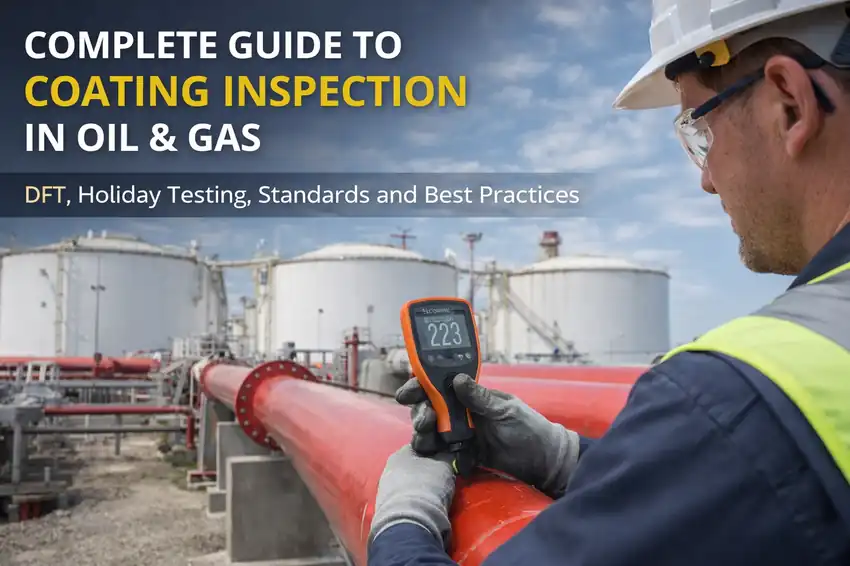

Protective coatings are a primary corrosion-control barrier for oil and gas assets such as pipelines, storage tanks, offshore structures, pressure vessels, pipe racks, and structural steel. When coatings are applied correctly, they extend asset life, reduce maintenance costs, and prevent corrosion-related failures. When coatings are applied poorly—or inspected poorly—assets deteriorate faster, rework increases, and the risk of leaks, shutdowns, or safety incidents rises.
Coating inspection is not just “checking paint.” It is a structured quality control process that verifies surface preparation, environmental conditions, coating application, curing, thickness, adhesion, and overall integrity—against project specifications and accepted industry standards.
This pillar guide explains coating inspection in a practical, field-focused way: what inspectors check, when they check it, what instruments they use, which defects matter most, how to document results, and how to avoid the most common failures.
1. What Is Coating Inspection?
Coating inspection is the process of verifying that a coating system is applied in accordance with project requirements and will perform as intended in service. Inspection covers the full workflow—from substrate evaluation and surface preparation, through coating application and curing, to final acceptance testing and reporting.
A coating inspection program typically confirms:
- The surface is prepared to the required cleanliness and profile
- Environmental conditions are within limits for application and curing
- Correct materials are used (approved products, correct batch numbers, within shelf life)
- Mixing, thinning, induction time, and pot life are followed correctly
- Each coat achieves the specified Dry Film Thickness (DFT) range
- The coating is free from critical defects and discontinuities
- Adhesion and integrity meet specification requirements
- Documentation supports traceability and final handover
In oil & gas projects, inspection is a control point that protects both asset integrity and project compliance.
2. Why Coating Inspection Is Critical in Oil & Gas
Oil & gas assets face harsh service conditions, often simultaneously:
- Marine environments with salt-laden air and high humidity
- Buried conditions with soil moisture, stray currents, and microbiological influences
- Chemical exposure from process fluids, vapors, and spills
- Temperature cycling that stresses coating systems
- Mechanical damage from operations and maintenance work
Coatings fail faster when any of these occur:
- Surface salts remain and attract moisture under the film
- Surface profile is incorrect, reducing mechanical bonding
- Humidity/dew point conditions create condensation and flash rust
- DFT is too low (early corrosion) or too high (cracking/solvent entrapment)
- Holidays/pinholes allow localized corrosion or lining failure
A good inspector prevents these issues early—before they become expensive repairs.
3. The Coating Inspector’s Role and Responsibilities
A coating inspector’s job is to verify quality and compliance—not to “slow the job,” and not to approve poor work to keep production moving. Your value is in preventing failures.
Key responsibilities include:
3.1 Review Specifications and ITPs
Before field work starts, review:
- Coating specification and approved coating system
- Surface preparation standard and acceptance criteria
- DFT range per coat and total system DFT
- Environmental limits (temperature, RH, dew point spread)
- Cure requirements and recoat windows
- Inspection and Test Plan (ITP), hold points, witness points
- Required test methods (DFT, holiday test, adhesion test, etc.)
3.2 Verify Materials and Storage
Confirm:
- Correct coating product and system (primer/intermediate/topcoat or lining)
- Batch numbers and shelf life
- Storage temperature per manufacturer
- No contamination of components
- Thinner type is approved and used correctly
3.3 Control Surface Preparation Quality
Verify cleaning standard, profile, contamination control, and readiness for coating.
3.4 Monitor Application and Curing
Confirm correct mixing, pot life, film build control, and curing conditions.
3.5 Document Everything
Calibration, environmental logs, inspection results, NCRs, repairs, and re-inspection must be traceable.
4. Coating Inspection Workflow in 3 Phases
A practical coating inspection workflow is divided into:
4.1 Pre-Application Inspection (Before Coating)
This is where failures are prevented. Typical checks include:
- Substrate condition (pitting, weld quality issues, sharp edges)
- Previous coating removal confirmation (if maintenance job)
- Surface preparation method and achieved standard
- Surface profile measurement (anchor profile)
- Surface cleanliness verification (dust, salts, oil/grease)
- Environmental readings (RH, ambient, surface temp, dew point)
- Compressed air quality and abrasive condition (for blasting jobs)
No coating should start until pre-application acceptance is confirmed.
4.2 During Application Inspection (While Coating Is Applied)
Here you control consistency:
- Confirm mixing ratio, mixing method, and induction time (if applicable)
- Track pot life (especially for epoxies)
- Observe stripe coat coverage (edges, welds, bolts, cut-outs)
- Confirm WFT checks where required
- Verify spray technique, overlap, and avoidance of dry spray
- Confirm recoat intervals and surface condition before recoat
- Continue environmental monitoring
4.3 Post-Application Inspection (After Cure)
This verifies acceptance:
- DFT measurements per standard
- Visual inspection for defects
- Cure confirmation (as specified)
- Holiday testing for linings/immersion/buried service
- Adhesion testing if required
- Repair verification and re-inspection
5. Surface Preparation: The Foundation of Coating Performance
Most coating failures start at the surface. In oil & gas work, surface preparation is often the highest-risk stage.
5.1 Cleanliness Standards
Common preparation standards include ISO and SSPC/AMPP systems (as specified). Inspectors verify that the achieved surface condition matches the required grade.
5.2 Surface Profile (Anchor Profile)
Surface profile provides mechanical keying. Too low → poor adhesion; too high → DFT readings may be affected, high peak exposure risk, and potential premature coating breakdown.
Measure profile using the method specified (e.g., replica tape, profilometer) and record results.
5.3 Edge Preparation and Weld Quality
Coatings thin out on sharp edges. Good practice requires:
- Removing sharp edges
- Grinding weld spatter
- Smoothing rough welds where required
- Ensuring stripe coat on high-risk geometry
5.4 Dust and Cleanliness Checks
Dust can reduce adhesion and create coating defects. A dust test (as required) confirms surface is suitable.
5.5 Soluble Salt Contamination
Salts attract moisture under coatings and accelerate blistering and under-film corrosion. In coastal/offshore environments, salt checks are critical. Record test method, location, and results.
5.6 Oil and Grease Contamination
Oil/grease can come from compressors, handling, or process exposure. If contamination is suspected, verify cleaning effectiveness before blasting/coating proceeds.
6. Environmental Monitoring: Dew Point, Humidity, and Temperature Control
Environmental control is a daily field challenge—especially in coastal and offshore locations.
6.1 What to Measure
Inspectors typically monitor:
- Ambient temperature
- Surface temperature
- Relative humidity (RH)
- Dew point
- Wind/dust conditions (where relevant)
6.2 Dew Point Rule
A common acceptance rule is maintaining a safe spread between surface temperature and dew point (often stated in specifications). If surface temperature approaches dew point, condensation can form—leading to flash rust and poor adhesion.
6.3 Why It Matters
Bad environmental conditions can cause:
- Flash rusting after blasting
- Amine blush (in some epoxies) under humidity conditions
- Slow or incomplete curing
- Loss of gloss or chalking issues on topcoats
- Solvent entrapment risk when coating too thick in poor conditions
Your environmental log is a key document in any dispute or failure investigation.
7. Application Control: Mixing, Pot Life, Stripe Coat, and Recoat Windows
This is where many field mistakes happen.
7.1 Mixing and Induction Time
Some products require induction time after mixing. Skipping induction can cause cure issues and poor performance.
Always confirm:
- Correct component ratio
- Adequate mixing time
- Clean mixing tools
- Induction time requirement (if specified)
- Approved thinning only, within limits
7.2 Pot Life Control
Epoxy systems have limited pot life. Once pot life is exceeded:
- Viscosity changes
- Spray pattern becomes poor
- Film properties may be compromised
Inspectors should ensure expired material is not applied.
7.3 Stripe Coating
Stripe coat is essential for:
- Welds
- Edges
- Bolts/nuts
- Cutouts and stiffeners
- Complex geometry (brackets, angles)
Stripe coating increases coating thickness where spray application naturally becomes thinner.
7.4 Recoat Window Compliance
Recoating too early can trap solvent; recoating too late can reduce intercoat adhesion. Verify surface condition and timing against product data sheets and specification requirements.
8. DFT Measurement: The Core Acceptance Check
Dry Film Thickness (DFT) measurement is one of the most important acceptance criteria.
8.1 Why DFT Matters
- Too low → early corrosion and reduced barrier protection
- Too high → cracking, delamination, solvent entrapment, poor curing, and stress in the film
8.2 Gauge Verification and Calibration
Before measuring:
- Verify gauge calibration using certified standards/shims
- Zero check on the correct substrate type
- Confirm correct probe mode (ferrous/non-ferrous)
- Record calibration/verification results in the report
8.3 Measurement Technique
To get reliable readings:
- Keep the probe perpendicular
- Avoid sliding the probe
- Measure multiple points as per the sampling plan
- Average as required by standard/specification
- Record location/area IDs for traceability
8.4 Roughness Effect
On blasted surfaces, profile can influence readings. Proper zeroing and method compliance help avoid false compliance.
9. Holiday Testing: Discontinuity Detection for Linings and Critical Service
Holiday testing is used to detect pinholes and discontinuities that allow corrosion initiation or chemical penetration.
9.1 Where Holiday Testing Is Common in Oil & Gas
- Tank internal linings
- Buried pipelines and field joints
- Immersion service areas
- Chemical containment bunds and sumps (as specified)
9.2 Low Voltage vs High Voltage
- Low voltage (wet sponge): typically for thinner films
- High voltage (spark testing): typically for thicker linings
Voltage selection should follow coating manufacturer guidance and specification requirements to avoid damaging the coating.
9.3 Repair and Re-Test
Any detected holiday must be repaired using approved repair procedures and then re-tested to confirm integrity.
10. Adhesion Testing: When and Why It’s Required
Adhesion testing is often required in:
- Critical service or high-risk areas
- Qualification panels and mock-ups
- Dispute resolution or suspected failures
- Repairs and touch-up systems
10.1 Common Adhesion Methods
- Tape test (quick screening)
- Pull-off adhesion test (more quantitative)
10.2 Common Causes of Poor Adhesion
- Residual salts or dust
- Incorrect profile
- Poor curing conditions
- Overcoating outside recoat window
- Incompatible coating systems
Adhesion failures typically lead to delamination and rapid corrosion spread.
11. Visual Inspection: Defects That Matter
Visual inspection identifies surface and coating defects before acceptance.
Common defects and typical causes:
- Runs/sags: excessive WFT, poor spray technique
- Dry spray/overspray: wrong distance, low thinner control, wind
- Pinholes: poor application, outgassing, porous substrate
- Blistering: salts, moisture, contamination, improper cure
- Cracking: excessive DFT, brittle system, stress, thermal cycling
- Orange peel: viscosity, spray setup, technique
- Fish eyes: contamination (silicone/oil)
Inspectors should document defect type, location, severity, and corrective actions.
12. Special Coating Systems in Oil & Gas and Their Inspection Focus
Oil & gas sites often include specialized systems:
12.1 Zinc-Rich Primers
Watch for:
- Correct DFT to ensure protection without mud-cracking
- Proper curing before topcoating
- Correct solvent rub tests where specified
12.2 Glass Flake Reinforced Systems
Watch for:
- Achieving required build and uniformity
- Avoiding voids/pinholes
- Holiday testing requirements
12.3 Tank Internal Linings
Watch for:
- Strict surface prep and contamination control
- Full cure verification
- Holiday testing and repair procedures
- Compatibility with service (chemical/temperature)
12.4 Fusion Bonded Epoxy (FBE) / Pipeline Coatings
Watch for:
- Thickness control
- Holiday testing
- Handling damage checks
- Field joint coating inspection
13. Documentation and Reporting: What a Good Inspection Report Includes
A strong inspection report supports compliance and protects you during audits or disputes.
Include:
- Project and asset identification
- Coating system and batch numbers
- Surface preparation results (standard achieved, profile readings)
- Environmental logs (time-stamped)
- DFT readings and acceptance summary
- Holiday test results (voltage used, repaired areas)
- Adhesion results (if performed)
- NCRs, repairs, and re-inspection outcomes
- Calibration/verification records
- Signatures and approvals as required
Good documentation is professional evidence that the work met requirements.
14. Common Causes of Coating Failure in Oil & Gas
Most failures trace back to a few repeat problems:
- Poor surface preparation
- High salts or moisture under the film
- Environmental non-compliance during application
- Incorrect mixing/pot life misuse
- Incorrect DFT (too thin or too thick)
- Missed holidays in linings or pipeline coatings
- Poor intercoat adhesion due to recoat window violations
- Weak repair control and lack of re-testing
Your inspection system should be designed to prevent these.
15. Best Practices for Coating Inspectors
- Treat surface prep as the main risk stage
- Calibrate/verify gauges regularly and document it
- Take environmental readings consistently (not only once a day)
- Require stripe coating on edges/welds where specified
- Use a sampling plan for DFT and stick to it
- Document defects clearly with location references
- Verify repairs and re-test (DFT/holiday/adhesion as required)
- Maintain professional independence—report facts, not opinions
16. Inspector Field Tips That Improve Real-World Results
These are practical habits that prevent failures:
- After blasting, inspect quickly—flash rust can appear fast in humid areas
- Check compressed air quality; oil contamination can ruin coating adhesion
- Confirm abrasive condition; dirty abrasive re-contaminates steel
- Watch weld areas; they are the highest-risk corrosion points
- Don’t accept “average looks okay” — measure, record, verify
- If DFT is low in one area, expect geometry issues (edges, tight areas)
- If DFT is high, check for sagging, solvent entrapment risk, and cure issues
Small checks save big rework.
Frequently Asked Questions (FAQ)
A coating inspector verifies surface preparation, monitors environmental conditions, measures coating thickness, performs adhesion and holiday testing, and ensures compliance with project specifications and industry standards.
Dry Film Thickness (DFT) ensures the coating provides adequate corrosion protection. Too thin reduces durability, while excessive thickness may cause cracking or adhesion failure.
Common standards include SSPC-PA 2, ASTM D7091, ASTM D3359, ISO 8501, and AMPP coating inspection guidelines.
Holiday testing is performed after coating curing on tank linings, pipelines, and critical containment areas to detect pinholes and discontinuities.
Poor surface preparation is the leading cause of coating failure in oil and gas projects.
Conclusion
Coating inspection in oil & gas is a structured process that protects high-value assets from corrosion and premature failure. It starts before painting—at surface preparation and environmental control—and continues through application monitoring, thickness verification, holiday testing, adhesion checks, and final documentation.
A strong coating inspection program improves durability, ensures compliance with project specifications, reduces costly rework, and supports safe long-term operation. In oil & gas, coating inspection is not a formality—it is an essential integrity control.